




The Spec Sheet Trap: Ambiguity in Industrial Procurement
Vendors frequently obscure key tolerances—masking panel NIT values without glass attenuation, quoting controller poll rates instead of touch-to-pixel latency, or hiding air gaps behind deceptive "zero-fit" phrasing. Download the standardized arrival acceptance template below to inspect shipments against genuine factory benchmarks.
Module 1: Touch Performance Benchmarks
Differentiating true controller-level capability from physical user touch perception in high-traffic deployments.
Projected Capacitive (PCAP) vs. Infrared (IR) Performance Specs
Standardized at 10-point or 20-point multi-touch. Verify whether true independent coordinates are calculated or if ghost touches emerge when two fingers share identical horizontal or vertical grid lines.
Demands distinguishing USB report rate (<5ms) from actual touch-to-photon latency (≤15ms to ≤25ms). High lag degrades self-service kiosk checkouts and fast typing speeds.
Specifies stylus tip diameter (typically 2.0mm to 3.0mm active, 6.0mm passive). Anything above 8.0mm will fail precise signature capturing in retail POS terminals.
Maintained within ±1.0mm across 90% of the active surface, relaxing to ±1.5mm along extreme peripheral edges. Non-linear grid pitch results in significant cursor drift.
Arrival Verification: Load multi-touch diagnostic software (e.g., Windows Touch Test or Android Touch Diagnostic). Perform full diagonal boundary drawing across corners and execute simultaneous 5-point circular rotations to verify zero coordinate drift or jitter under 50Hz/60Hz fluorescent ambient interference.
Module 2: Visual & Display Performance Criteria
Assessing true optical output, backlight endurance, wide viewing angles, and color rendering accuracy.
Luminance, Dynamic Contrast, and Gamut Thresholds
Indoor: 250 - 350 cd/m² (NIT). Semi-outdoor / Direct Window: 700 - 1000 NIT. Direct Sunlight: 1500 - 2500+ NIT with automated ambient light sensor (ALS) dimming circuits.
Static contrast ratio of 1000:1 to 3000:1. Screen luminance uniformity must surpass 85% calculated via 9-point luminance matrix measurement to prevent dim edges.
Specified at 178° Horizontal / 178° Vertical (CR≥10). Low-grade TN panels show extreme color inversion at steep angles in unattended interactive kiosks.
Minimum 72% NTSC (equivalent to ~99% sRGB) for true brand identity reproduction, retail digital signage, and self-order visual accuracy.
Arrival Verification: Place an optical luminance colorimeter (e.g., Konica Minolta CS-200) perpendicular to the center point over full white raster (Pattern 100% IRE). Confirm net output meets the 1000 cd/m² figure after penetrating the touch cover glass, AR/AG layers, and lamination adhesives.
Module 3: Structural Integrity, Bonding & Environmental Ingress
Mechanical robustness engineered for public resilience, zero condensation, and liquid barrier sealing.
Mohs Hardness, Optical Bonding (OCA/OCR), and IP Ingress
Chemically strengthened tempered glass meeting ≥7H Mohs rating (or IK08 / IK10 impact ratings). Resists deep scratches from metallic keys, coins, and accidental vandalism.
Full Optical Bonding (OCA/LOCA) eliminates the air cushion between panel and glass, permanently mitigating internal condensation, parallax error, and internal surface reflection.
IP65 front-sealed surface blocks direct jet spray and spilled liquids. Requires cellular closed-cell EPDM or poron perimeter gasket sealing integrated with the chassis.
Anti-Glare (chemical etching <5% haze), Anti-Reflective coating (surface reflection <1.5%), and oleophobic Anti-Fingerprint coatings (>110° water contact angle).
Arrival Verification: Carry out a calibrated water drop contact angle test (>110° confirms genuine AF coating). Run standard pencil hardness test at 45 degrees, and inspect perimeter bezel gaskets under optical magnification for uniform micro-compression without gasket pinch points.
Module 4: Reliability, Burn-in & Operating Tolerances
Ensuring non-stop 24/7 continuous operations across demanding industrial and commercial environments.
MTBF Standards, Thermal Range, and Stress Burn-in Cycling
Demands ≥50,000 continuous operating hours for commercial backlight units (LED half-life) and ≥100,000 hours for industrial embedded motherboard controller boards.
Standard Commercial: 0°C to +50°C. Wide-Temperature Industrial Grade: -20°C to +70°C (-4°F to 158°F). Storage rating down to -30°C without liquid crystal phase shifting.
Documented burn-in cycling at 40°C ±5°C with 85% Relative Humidity under full-power looping video for a minimum of 24 to 72 continuous production hours.
Air discharge ±15kV, contact discharge ±8kV per IEC 61000-4-2 standard. Prevents driver IC latch-up and false touches generated by human static discharge.
Arrival Verification: Review certified factory batch burn-in sign-off logs. Perform cold-start boot sequence inside a environmental testing chamber at sub-zero operating limit, followed by immediate electrostatic air discharge probe sweeps around active I/O ports.
Complete Arrival Inspection Protocol & Checklist
Standardized incoming inspection procedures to prevent defective batches from entering assembly lines.
1. Exterior & Mechanical Casing
Confirm aluminum or sheet-metal chassis tolerances via digital vernier calipers. Check paint adherence, galvanic isolation, grounding studs, and VESA mount thread pitch integrity without metal shavings.
2. Touch Grid & Latency Point-by-Point
Use conductive test probes across a 100-cell onscreen matrix grid. Test drag accuracy across extreme bezel corners. Verify palm rejection performance and hover rejection thresholds within spec limits.
3. Uniformity & Sub-Pixel Screening
Cycle solid Red, Green, Blue, White, and Black rasters. Audit for bright/dark stuck sub-pixels against ISO 9241-307 Class I or Class II requirements. Screen for edge light bleeding in total darkness.
4. Optical Bonding Delamination
Audit OCA adhesive layers using a collimated cold backlight table. Reject units demonstrating micro-bubble aggregation (>0.2mm), polar optical Newton rings, or perimeter edge delamination peel.
5. Hardware Interfaces & Bus System
Connect HDMI, DisplayPort, USB-C alternate modes, RS232 touch controllers, and Ethernet ports. Validate hot-plug auto-handshake and extended EDID signal timing resolution locks under continuous loop.
6. Documentation & Certification
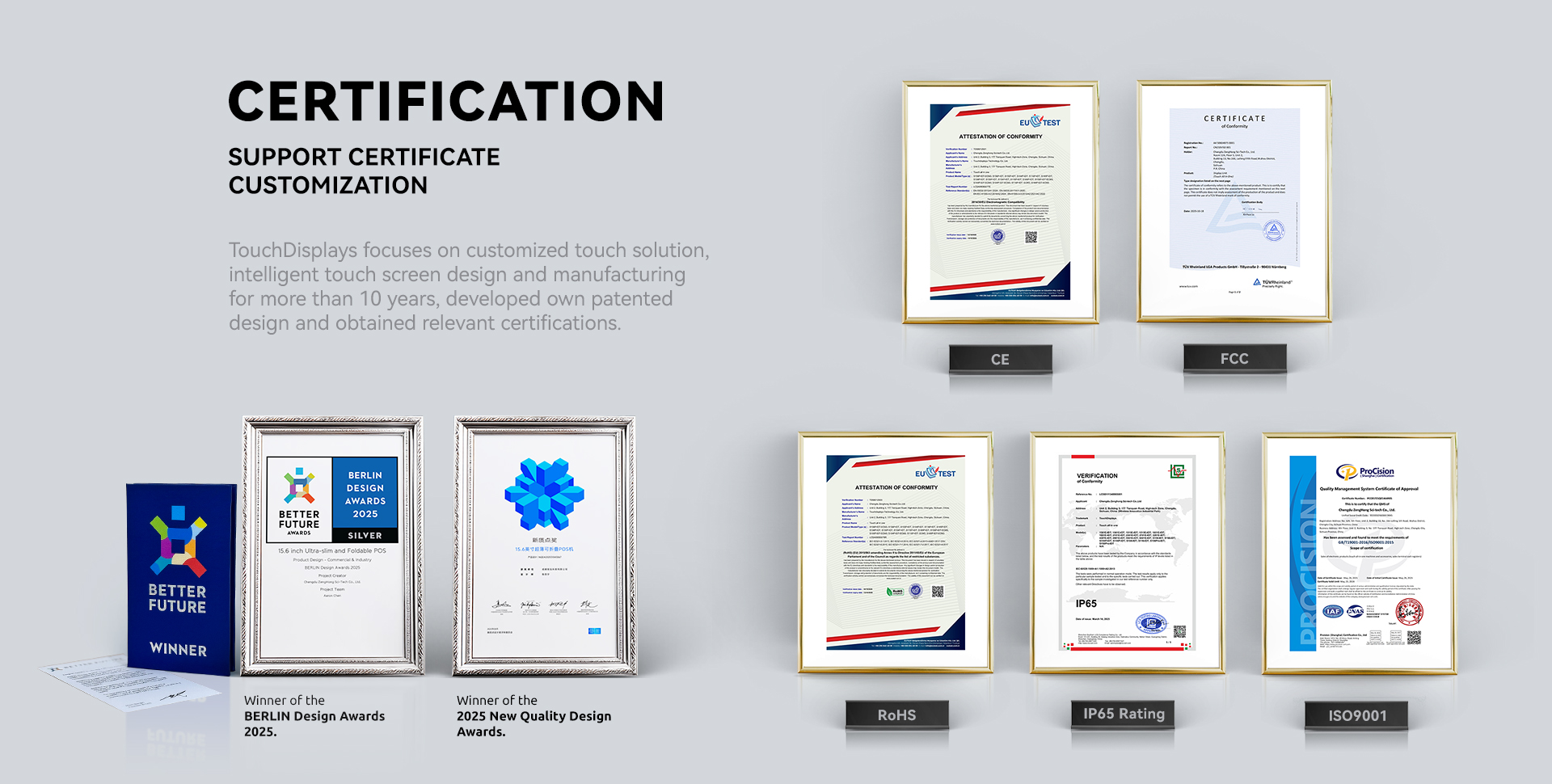
Match serialized label barcodes with certified factory test cards, Certificate of Conformity (CoC), CE, FCC, RoHS certifications, and signed warranty duration agreement certificates.
Original Equipment Manufacturer Scope & ODM Engineering Capabilities
Transforming custom POS, IDS, and kiosk concepts into deployable commercial hardware since 2009.

Flagship POS Terminals
High-precision touch integration designed for retail transactions and heavy hospitality duty.

Interactive Displays
Engineered for high-footfall environments with true flat seamless touch interfaces.

Industrial Custom Enclosures
Modular form factors accommodating embedded scanners, direct receipt printers, and smart sensors.
 Tailored Dimensions
Mounting Flexibility
Custom Shell Colors
Mechanical Optimization
Thermal Dissipation
Impact & Shatter Guard
Ultra HD Panels
High NIT Backlights
Embedded Printers
Integrated Barcode / QR
RFID / NFC Readers
Integrated Webcams
Case Studies: Practical Deployments
Real-world integration delivering verified reliability under diverse field conditions.

Franchise Photo Booth Systems
Touch all-in-one machines engineered for continuous camera integration, flash sync, and rapid guest processing.

End-to-End System Customization
Seamless motherboard-level adaptations delivering uniform thermal control and high-performance computing.

Supermarket & Parking Lots
High-reliability payment touch terminals built to withstand constant physical interactions and outdoor temperatures.

Dust-Free Clean Room Assembly
Precision manufacturing preventing sub-micron particulate contamination during full optical bonding processes.

Thermal & Humidity Cycling
Comprehensive burn-in testing chambers validating performance under stress before shipment sign-off.

Certified Global Compliance
Strict conformity with UL, CE, FCC, RoHS, and internationally recognized manufacturing benchmarks.

Procurement FAQ: Engineering Guidance
Direct answers to common technical, financial, and logistical procurement considerations.
How should engineers choose between PCAP and IR touch technologies?
Projected Capacitive (PCAP) is optimal for sleek, bezel-less edge-to-edge glass designs requiring multi-touch gesture fluency (e.g., pinch-to-zoom), signature capture, complete liquid-tight sealing (IP65), and high vandal resistance. Infrared (IR) touch suits large-format displays (>65 inches) or applications requiring activation with heavy gloves or thick materials, though recessed bezels may accumulate dirt or fail under direct sunlight.
What brightness rating is truly adequate for my application environment?
For strictly climate-controlled indoor environments (indoor retail, food service order stations, factory floor automation), 250 to 350 cd/m² (NIT) provides adequate legibility. For spaces with ambient glass ceilings, storefront display windows, or semi-outdoor canopies, specify 700 to 1,000 NIT. Direct open-sky outdoor installations require a minimum of 1,500 to 2,500 NIT paired with optical bonding and Anti-Reflective (AR) glass treatments to maintain contrast ratios above 10:1.
What is the contractual protocol when arrival inspection lots fail acceptance?
Every commercial procurement agreement should specify clear AQL thresholds (typically ISO 2859-1 Level II). When non-conformances (such as out-of-spec dead pixels, optical adhesive delamination, or coordinate drifting) exceed acceptable limits, quarantine the affected lot immediately with photographic and video evidence alongside system test logs. Demand a formalized 8D Corrective Action Report from the factory alongside rapid replacements or commercial credit adjustments.