




China Touch Screen Sourcing: Supplier Verification & Export Compliance Checklist
Mitigate customs impoundment, sub-tier quality drift, and test mismatches. The strategic B2B sourcing guide to auditing cleanroom assembly, SMT controllers, and global CE/FCC/RoHS regulatory certifications.
⚙ High-Precision ODM Manufacturing & Global Footprint
Transforming custom POS, Interactive Digital Signage (IDS), and self-service KIOSK concepts into mass production since 2009. Engineered for enterprise resilience.
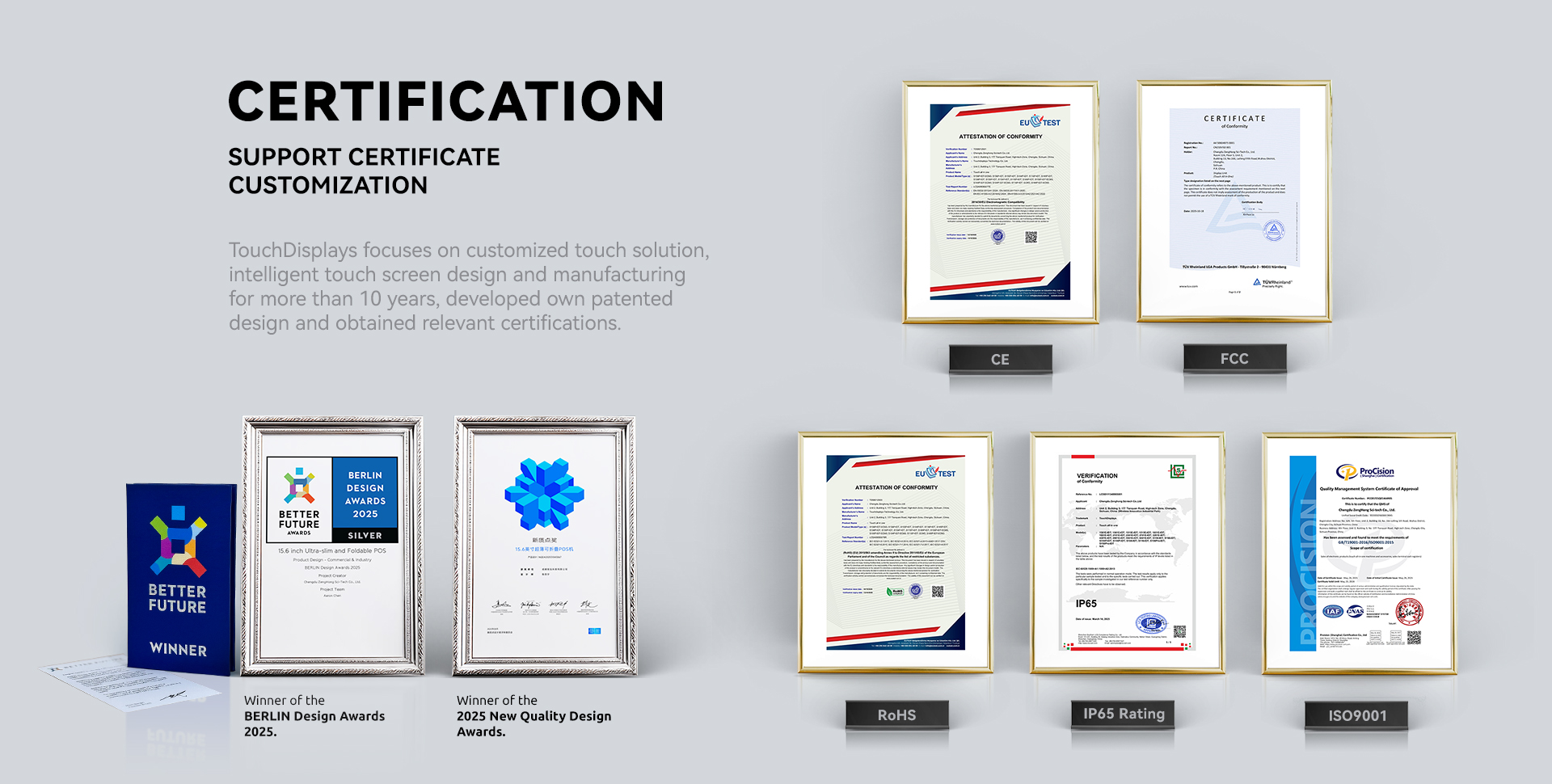
⚠ First-Screen Warning: The Two Costliest Sourcing Oversights in Touch Screen Procurement
Procuring capacitive or resistive industrial touch terminals from China presents engineering pitfalls beyond price negotiation. Overseas buyers routinely incur thousands in customs penalties and line-shutdown costs due to two latent procedural omissions:
✖ Certification Model Mismatch
Importers receive genuine test paperwork, but the accredited lab reports cite standard generic control modules (e.g., base 15" driver PCBA) rather than the modified SKU, higher-nit backlight, or custom I/O integrated into your build. In customs clearance, mismatched product codes in CE DoC or FCC ID reports lead to outright seizure or destruction.
✖ Subcontracted Critical Processes & Batch Fluctuation
Suppliers claiming "turnkey production" frequently outsource ITO film-glass optical bonding, COF/COG micro-soldering, or motherboard SMT to unmonitored second-tier workshops. This leads to inter-batch variations in touch latency, parallax misalignment, and accelerated delamination under harsh thermal conditions.
✔ Touch Screen Supplier Verification Checklist
Execute an uncompromising 6-pillar supplier qualification prior to issuing down payments or tooling contracts.
1. Genuine Factory vs. Broker
Scrutinize business licenses for "Manufacturing and Processing" designations rather than "Wholesale/Trading." Demand an unedited live walkthrough verifying Class 10,000/1,000 cleanrooms, optical lamination presses, and fixed capital equipment registered to their legal entity.
2. In-House SMT & Aging Tests
Inspect SMT line capability for driving touch controller boards (e.g., EETI, Ilitek). Validate temperature-controlled burn-in ovens and high-humidity chambers where assembled touch monitors undergo a minimum 24-to-72 hour operational stress cycle before final packing.
3. ISO 9001 Scope Authenticity
Do not simply verify certificate validity on CNCA databases; confirm the explicit scope statement includes "Design, development, and manufacture of touch display devices, touch all-in-one panels, or POS hardware" instead of unrelated peripheral assembly.
4. Direct Model-Matching CE/FCC
Cross-check test certificates against target BOM components. EMC and RED reports must specifically enumerate your model family, display controller IC, internal SMPS power supply unit, and peripheral motherboard without vague catch-all nomenclature.
5. Deep ODM vs. Snap-Together Assembly
Distinguish genuine ODM capability from "screwdriver assembly." True vendors engineer mechanical structural molds, thermal dissipation paths, custom display timing boards, BIOS-level touch controller calibration, and waterproof bezel seals.
6. Tier-1 Global Track Record
Request demonstrable proof of past OEM/ODM export deployments across retail POS, transit kiosks, and smart medical consoles. A reputable supplier readily presents anonymized customs shipping declarations (B/L) and test samples built for Fortune 500 standards.
📄 Export Compliance & Mandatory Customs Documentation
Flawless customs clearance demands an uninterrupted paper trail from raw materials to Bill of Lading.
| Document Designation | Primary Audit Point for Touch Screens | Regulatory Purpose | Compliance Priority |
|---|---|---|---|
| Commercial Invoice (CI) | Full description including display diagonal, touch tech (PCAP/Resistive), HS code (8528.52/8528.59), and unit valuation matching export declarations. | Tariff classification, anti-dumping checks & customs duties valuation. | Mandatory |
| Detailed Packing List (PL) | Net/gross weights per pallet, exact unit quantities per anti-static carton, and outer shock/drop warning indications. | Port handling, terminal verification, container weight distribution. | Mandatory |
| Certificate of Origin (CO / Form E/A) | Verification of qualifying local manufacturing operations within the audited city of production. | Preferential tariff treatment, country of origin verification. | Duty Relief |
| CE DoC & Test Reports (EMC, LVD, RED) | Specific testing against EN 55032/EN 55035 for electromagnetic emissions, EN 62368-1 safety, and Wi-Fi/Bluetooth testing if equipped. | Legal market access across all 27 European Union member states. | EU Requirement |
| FCC Part 15B / Supplier's DoC (sDoC) | Class B commercial/residential radiated emissions test reports covering the complete touch panel unit and embedded motherboard. | United States FCC clearance; verification of low RF disruption. | US Requirement |
| RoHS Directive 2011/65/EU & REACH SVHC | Quantitative testing of 10 restricted heavy metals and phthalates on screen glass coatings, adhesives, cabling, and solder joints. | Environmental import clearance, toxic containment certification. | Mandatory |
| Destination-Specific Mandates (UKCA / UL / PSE) | Regional electrical and fire-resistance conformity (e.g., UL 94-V0 flame-retardant enclosures, UKCA for Great Britain). | Local electrical utility safety and commercial installation liability. | Market Conditional |
🖥 Verified Touch Hardware Architectures
Create infinite possibilities for enterprise terminals. From single-point industrial monitors to modular multi-function POS ecosystems.


🛠 End-to-End ODM / OEM Scope: What We Do
Make consumers' and enterprise needs transform seamlessly from raw idea to market reality.

Dimension & Installation
Shell Color Customization
Structure Design
Heat Dissipation Engineering
Explosion Proof / IK Rating
Ultra HD High-Resolution
High Brightness Sunlight Readability
Embedded Printer Integration
Integrated 1D/2D QR Scanner
ID / RFID / NFC Reader
Integrated HD Webcam
Extreme Environment Solutions
Custom Motherboard & BIOS
Certificate Authentication

Appearance Customization

Function & Firmware Customization


📊 Field Case Studies & Practical Application Verification
Find the best solution through continuous practical exploration and demanding customer audits.


🏭 Certified Cleanrooms, SMT & Lab Audits: Why We Are Different
Focus on the present and innovate the future with observable, verified quality controls on the shop floor.


❓ Frequently Asked Questions on Verification & Compliance
Direct technical answers to common touch screen sourcing dilemmas faced by procurement teams.
Submit Your Target Market & Product Type to Receive a Customized Compliance Checklist
Eliminate border holds and protect your brand equity. Contact our engineering team with your display specifications, target export destination, and custom module needs to receive a comprehensive factory audit rubric and regulatory roadmap.
Submit Target Market & Product Type for Compliance Checklist